Independent users and organizations
Members, resident teams, visitors and operators may come from unrelated organizations, identity systems and email domains.

Coworking and flexible-space operators
Coordinate members, teams, rooms, desks, equipment and services while operators retain visibility and control across one or many locations.
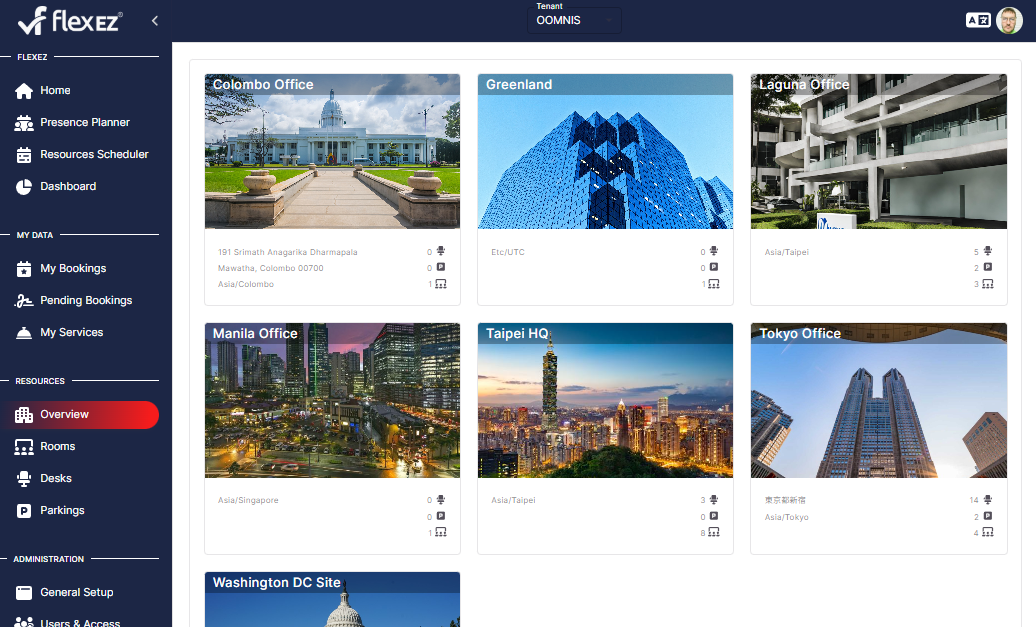
Flexible-space operations
Operators must balance a simple member experience with changing access, resource and service rules.
Members, resident teams, visitors and operators may come from unrelated organizations, identity systems and email domains.
Desks and rooms sit alongside booths, event spaces, equipment, parking and other shared assets.
Bookings may trigger setup, catering, technical support or facilities work.
Operators need practical evidence of demand, availability and use across locations.
Why operators deploy flexEZ
The resource model, policies and interfaces can adapt to the way each flexible-space business operates.
Manage a local community and a varied inventory with a clear, branded booking experience.
Why flexEZ
One configurable system reduces manual coordination as resources, services and membership rules evolve.
Offer consistent discovery and booking across sites while preserving local rules.
Why flexEZ
Central visibility and location-level policies help operators scale without making every site identical.
Coordinate spaces shared by departments, project teams, partners or visiting employees.
Why flexEZ
Identity, eligibility and resource policies can reflect who may use each space and under what conditions.
Reserve larger spaces together with equipment, preparation and supporting services.
Why flexEZ
Connected requests give operational teams the full booking context instead of scattered emails and forms.
Extend booking to studios, production equipment, lockers, vehicles or other shared assets.
Why flexEZ
Deep customization allows new resource types and workflows to fit the operator’s actual offer.
Make each reservation clear for the user and actionable for the operator.
Let users sign in with their own flexEZ credentials or an approved connected identity, then apply location, group, access and booking permissions.
Search availability by location, capacity, amenities and resource type.
Attach setup, catering, technology or other requirements.
Use schedules, status and analytics to manage the space and refine the offer.
Combine booking, service and physical-workplace functions around the operator’s model.
Manage availability, capacity, amenities, policies and room displays.
Support flexible seating and discovery through interactive plans.
Attach operational requests and additional resources to reservations.
Understand booking activity and utilization across resources and locations.
Show availability, directions and relevant information around the space.
Add supported local sensors where measured space use is needed.
Different users can work from shared information with interfaces and permissions suited to their role.
Find and reserve the right space or equipment with less uncertainty.
See upcoming use, help users and coordinate day-to-day changes.
Manage policies, services, locations and evidence for planning decisions.
The fully capable flexEZ scheduler does not require every coworking member to belong to one Microsoft or Google environment.
Members can access flexEZ with their own credentials while the native scheduler manages resources, availability and booking rules.
Enable Gmail OAuth and connect authorized Microsoft 365 or Google Workspace environments when users or operators need calendar integration.
Adapt sign-in, interfaces and data exchanges to the operator’s established systems and policies.